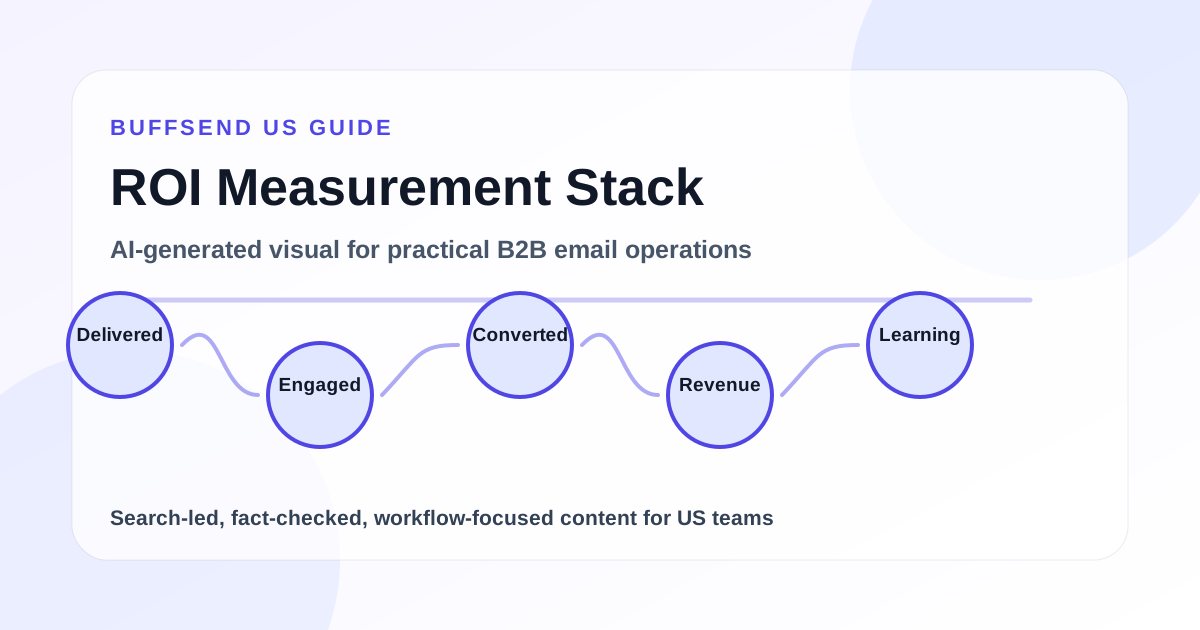
Measuring Bulk Campaign ROI Beyond Opens
Open rates are a noisy proxy, increasingly distorted by privacy features and client behavior. To understand the business impact of bulk campaigns, focus on metrics that trace value from inbox to revenue.
1) Define north-star outcomes
- Replies and meetings for outbound.
- Sign-ups, activations, and expansions for product-led growth.
- Pipeline and revenue for sales-led motions.
2) Connect data
Integrate email events with CRM and product analytics. Attribute replies and conversions to sequence, step, sender, and audience segment. Close the loop.
3) Use cohorts and control groups
Compare like-for-like segments over time and against holdouts to isolate lift from the program rather than noise from the market.
4) Track cost of sending
Include credits, infrastructure, and people time. ROI equals net value over total cost—measure both to make smarter scaling decisions.
Key takeaway
Measure what matters to the business. When you optimize for replies, revenue, and retention—not just opens—you’ll steer the program toward durable growth.
Attribution tactics that work
Use unique reply‑to or tracking for high‑stakes experiments, but avoid over‑tagging that bloats links. For meetings, capture the source on booking and confirm at show time. Tie product events to email variants when feasible. When uncertainty remains, analyze lift by cohort rather than obsessing over perfect precision.
Cost discipline
Track sending costs, verification spend, and staff time. Include the opportunity cost of incidents (pauses, rework). ROI improves as your program stabilizes and the ratio of high‑intent cohorts grows. Treat cost reductions that don’t harm outcomes as wins equal to revenue gains.
Executive summary
Summarize each month with three things: what improved, what regressed, and what you’ll try next. Pair numbers with plain‑language explanations. Over time, this creates institutional memory that speeds decision‑making and clarifies why certain rules exist.
Common pitfalls
- Optimizing for opens instead of replies or revenue.
- Ignoring costs—credits, tools, and time—when declaring wins.
- Attributing everything to email when multiple channels are active.
- Switching KPIs too often, which obscures progress.
Next steps
Define one north‑star outcome per motion, set up basic attribution, and create a monthly ROI summary. Improve from there. Clarity beats complexity when you’re building a measurement practice that lasts.
Case note
A team shifted from open‑rate targets to reply‑led goals. Within two months, they reduced link density, simplified copy, and reallocated volume to their most engaged segments. Opens fell slightly, but replies and meetings rose 24%, and pipeline attribution improved because measurement matched the true objective.